

So You Want to Read for Free?
Mar 22, 2026


Literary journal of the Northern Writers Forum.




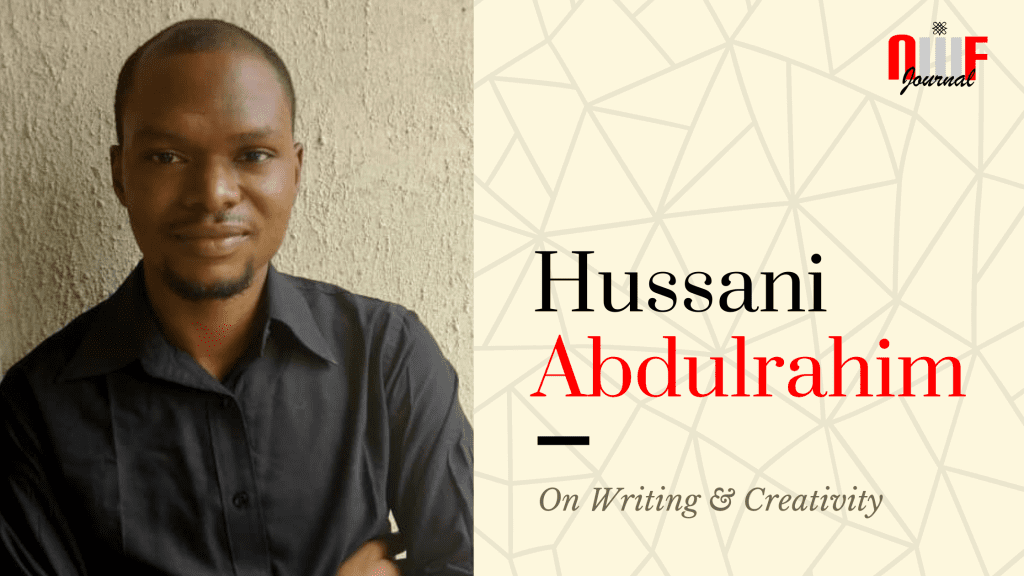
Hussani Abdulrahim is a storyteller from Kano whose fiction wanders into the unusual, where innocence and violence, memory and dream, walk side by side. His work has earned him the Toyin Falola Prize (2022), the Kendeka Prize (2023, runner-up), and Ibua Journal’s Bold Call, among others. Yet beyond the prizes, what lingers is the strangeness of his worlds—the way they disturb and console in the same breath. Hussani does not write to capture life as we know it, but to show us how life looks when tilted ever so slightly, when the curtain shifts and another possibility peers through.
Seeing that every writer begins first as a reader, when you think back to your earliest reading years, what kinds of books lived in your hands? Which works or voices still reflect through your writing today?
Looking back, I was fascinated by the stories in my English textbooks, both in Primary and Secondary classes. And then, when we were introduced to literature proper, the first serious text I encountered was Cyprian Ekwensi’s An African Night’s Entertainment. It was fascinating that something like this could exist. And then came The Passport of Mallam Illia by the same author. Kola Onadipe’s The Boy Slave. The Drummer Boy was there too. These were stories that seeped into my small, curious mind, inundating it with more curiosities. Looking back, I refer to that period as my years of bliss, where I questioned why tragedy should exist in the stead of so much beauty, why the world was steeped in cruelty (the worlds in these texts) instead of peace and love that abound. Why should Mallam Illia and Abu Bakir suffer for love? Why did Zahrah die (in The Passport of Mallam Illia)? There was so much potential for good, for love to endure, for peace to exist. It was confusing. That was my bubble, but as I grew, as I, too, experienced the real world, I realised that the worlds in those texts were real, not just made up because the authors wanted me to suffer and mourn the tragedies they often concocted.
Your work continually arises from the intersection of violence, innocence, and surrealism, something a little bit outside our everyday life. What wound, or reality, whether personal, ancestral, or cultural, do you feel is speaking through you?
I think, as a people, collectively, we’ve experienced tragedies that affect everyone in more ways than one. Wars fought even before we were born affect the way we exist as a people today. Decades of bad leadership, greed, and corruption have led Nigeria here. I’ve experienced religious crisis and election season chaos while growing up in Kaduna. The death of my father has also shaped me. My mother’s grief, our grief. There are wounds everywhere one turns in this country, and beyond. Personal and communal wounds. One wakes up to violence every day. See what is happening in Gaza. See what is happening in the Congo, in Sudan. See the rot happening in Nigeria. These things escape into one’s writing without one even knowing it, because no matter how strange a story is, mine in this case, it is still the synthesis of the real world, of memory, of the tragedies we encounter daily. And the thing is, we live such interconnected lives, even though we don’t often admit it. Another person’s tragedy is mine. We mourn when others mourn. But ultimately, even though it gets increasingly dismal by the day in the face of so much global chaos, I still believe in our capacity to be good.
Your stories inhabit a beautiful strangeness. Have you ever written something that frightened even you, something that made you pause and wonder if you had crossed a line?
I don’t think so (laughs). Maybe at first, but I don’t really remember. Writing is a beautiful thing (especially when it’s going smoothly). I have always believed in pushing the boundaries of imagination, finding novel ways to render possibilities into being. That’s why I love speculative fiction; it gives you room to make things happen, to make the mundane uncanny, to seek novelty, and yet be able to use that novelty to interrogate or highlight the familiar. I don’t get frightened; I often marvel at what I’m able to put down on paper.
Why do your characters so often face impossible choices? Do you believe human life itself is always structured by impossible choices?
I think so. Sometimes, we often find things easy in life, and this can make us forget that there is someone out there who doesn’t know where their next meal will come from, someone who must break a mountain or do something radical before they can fend for their family. Recently, I was talking with my younger sister, who is a university student, and she told me that a student died of hunger, even though she said she couldn’t confirm if it was a student in her university or from elsewhere. The main point is that someone died of hunger. We sit in relative peace and only hear of the wreckage of war-torn places and shudder at the thought of living in fear, in ruin, devastation, grappling with loss and trauma, and hunger. And all these are the realities of other people. You think the worst has happened to you, and then you read. You think there’s no sorrow greater than your sorrow, but then you turn on the TV and see wreckage everywhere. In essence, what I’m trying to say is that impossibilities abound, and what we get in books is a kinder version of what goes on in our real world; hence, books are seen as a vehicle of escapism.
When I read a good story, I automatically, more often than not, begin to think of a thousand and one fresh ways it could be rendered.
Some of your ideas feel as if they arrive smuggled in from elsewhere. Where do they actually come from, dream, memory, myth, or something more unnamable?
I try to make sense of the world I live in. Basically, that’s it. And perhaps, I should say, my ideas stem from a restless mind, from the things I read. When I read a good story, I automatically, more often than not, begin to think of a thousand and one fresh ways it could be rendered. I think I’m always in pursuit of something nebulous, something out of reach, something I myself can’t readily define. I have a malcontented mind, in the sense that I’m always seeking to outdo a previous deed, to be in competition with myself, a nomad in search of the perfect home. And when you are obsessed like that, steeped in that way of existing, of being a writer, ideas keep finding their way to you, I guess. Thus, my ideas are a culmination of what I take in daily. It becomes a net aggregation of what is stored and can be salvaged from memory. Everything comes from memory. My subconscious is a storage facility where everything I learn, read, and hear is stored. I imagine it to be a dusty, disorganised warehouse. So, I trust my subconscious, my imagination, to lead me on.
Do your stories arrive whole, or do they begin as faint hauntings that pursue you until you give them form?
No, they don’t usually come whole. I believe stories come in fits and bursts. And it’s up to the writer to be the goldsmith, take the raw metal, smelt and beat it into shape. What people see is the final product, without often knowing that a lot goes into shaping a story. My stories often take time to become whole. I spend a lot of time thinking about it, trying to visualise the shape of it, before deciding to even start writing anything. So, it’s often a long process, really.
Which writers serve as your creative anchors, the ones you return to, not merely for inspiration but for the kind of companionship only literature provides?
A tough question. But I’d say Abubakar Adam Ibrahim. It’s so easy to get swept up in his stories. And recently, I’ve been reading some interesting authors whose works I’m certain I’d return to (Max Porter, Stephen Buoro, Chigozie Obioma, Fiston Mujila Mwanza, Jonathan Escoffery, etc.)
When recognition finds you, what do you make of it; does it steady you, or does it unsettle the private silence from which you write?
I think it does both. It affirms your hard work and talent, and the fact that someone or people see it acts as fuel, giving you belief in your capabilities. Still, you know you have to deal with people, engage with them in different capacities, and this is often a nightmare for a reserved person like me. But all I can do is try to be the best I can be at all times.
When you revisit your early stories, do you still recognise the writer who wrote them, or do they now feel like the mind of a stranger?
It is often the latter. I look back at some stories and wonder how I came about them. It is amusing just thinking about it.
What is the question you hope no one will ever ask you, and if you dare, will you answer it here?
Nothing really comes to mind (laughs). I don’t think there is any question I wouldn’t try to answer, except if I don’t know the answer. And perhaps that is where Hussani Abdulrahim leaves us: in the space between certainty and wonder, where even silence has its own story to tell. Our thanks to him for opening those doors, and to you, dear reader, for stepping through them with us.