

Poetry Without Borders: A Conversation With Ismail Bala
Jan 13, 2026

Literary journal of the Northern Writers Forum.







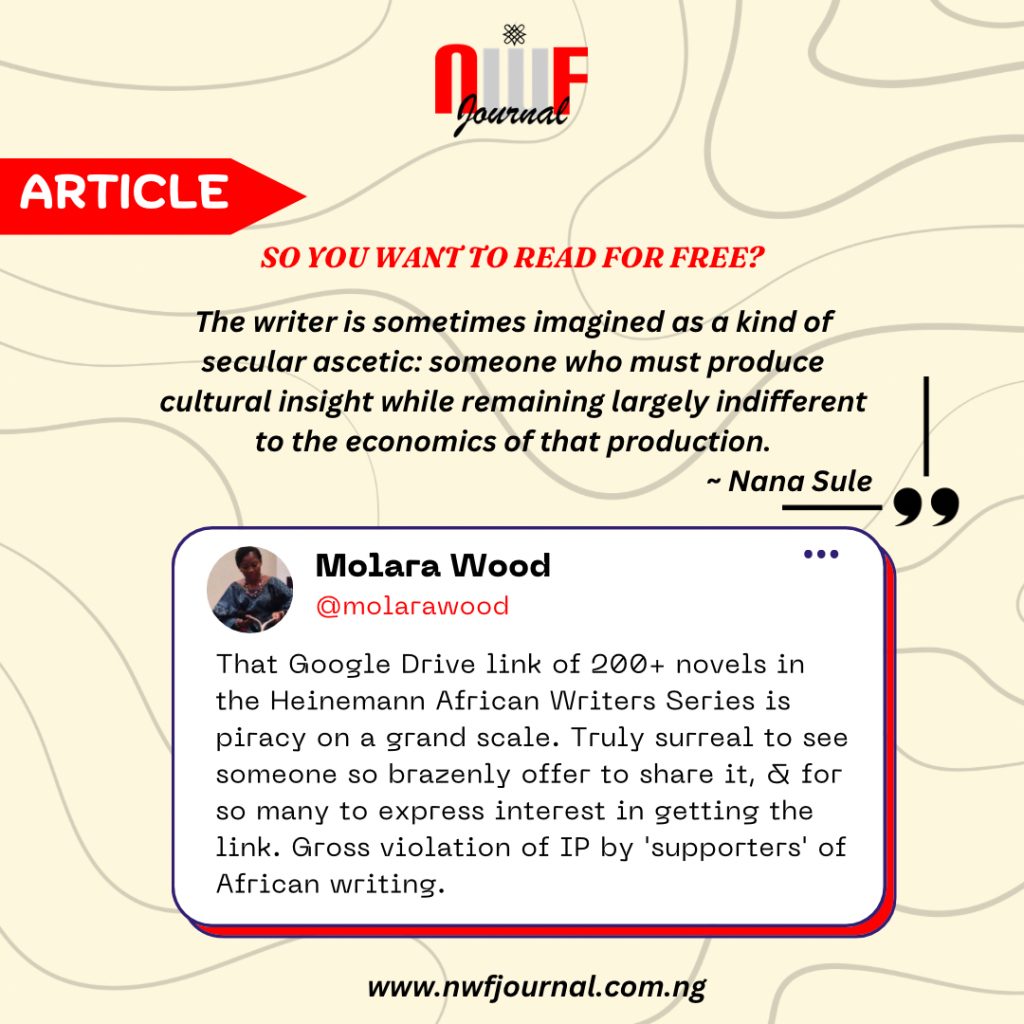
A few days ago, a small incident on Twitter (I still refuse to call it X) unfolded into a larger cultural argument about books, access, and ownership.
A user announced that he had created a digital archive of books from the Heinemann African Writers series. I assume his intention was to create a repository where readers could download and read these books that have shaped the continent’s literary imagination. The tone of the announcement suggested generosity. It presented the archive as some kind of cultural service: a digital shelf of important texts made available to anyone with an internet connection.
Then Molara Wood quote-tweeted the post and described the archive in more direct terms: piracy. Her entry into the conversation and the use of the word itself, reorganised the conversation. Within hours, the familiar architecture of an online debate emerged. People chose sides. The threads lengthened. Screenshots travelled.
But, underneath the speed of the reactions are a set of slower questions we should all be mulling over. Questions about how literature circulates, who pays for it, and who is expected to sustain it.
The Moral Clarity of Piracy
The first part of the argument is relatively straightforward. Uploading copyrighted books to a public digital archive without the consent of the author (or as they have mostly gone to the land of no return, those who hold their rights in trust) or publisher, is piracy. There are no shortcuts, no explanations to deny that it is what it is. The fact that the archive contains African literature, or that it is framed as a project of preservation, does not fundamentally alter that legal and ethical description.
Books are not only cultural objects; they are also the result of labour. The writing of a book often takes years. Around the manuscript grows an entire ecosystem of editorial work, design, printing, distribution, publicity, and bookselling. When books circulate outside that ecosystem without permission, the system that sustains literary production (I daresay, especially the writer, because she is at the very bottom of the food chain) absorbs the loss.
“To pretend that piracy carries no consequences for writers is to misunderstand how precarious literary labour already is”
This matters particularly in a literary economy that is already fragile. Most writers, especially in African contexts, do not earn stable livelihoods from their books. The margins are small, even when everything functions properly. To pretend that piracy carries no consequences for writers is to misunderstand how precarious literary labour already is. And quite frankly, it is unfair.
The Economic Context of Reading
Yet the opposing argument in the debate cannot simply be dismissed.
The economic context within which reading now takes place is difficult to ignore. In Nigeria, for example, inflation has altered the texture of everyday life. Food prices rise steadily. Transportation costs fluctuate unpredictably. Electricity appears and disappears with its own peculiar rhythm. It is safe to say that this giant of Africa is morphing into a bony thing with wobbly knees.
In an environment like ours, the price of a book begins to feel disproportionate. A novel priced at several thousand naira competes with necessities that are more urgent, to be sincere. When readers say they cannot afford books, they are often speaking from a genuine economic constraint rather than a casual unwillingness.
The question of access, therefore, is not invented. It is a real question, a real conversation that must be had.
“Reading, despite the rhetorical respect we often grant literature, occupies a relatively fragile place in the hierarchy of everyday spending.”
The Question of Cultural Priority
And yet, there is another layer to this conversation that we must have.
You see, people routinely find ways to pay for what they collectively consider important. We purchase data subscriptions without extended moral debate. We subscribe to streaming platforms. We buy new phones, attend weddings, contribute to aso-ebi, and fund social obligations that we understand as culturally necessary.
Sadly, and this makes me sad, mostly cause I am a writer, books rarely occupy the same level of urgency. This observation is not an accusation; it is a reflection on cultural priorities. Reading, despite the rhetorical respect we often grant literature, occupies a relatively fragile place in the hierarchy of everyday spending. From where I sit to type this, it suggests to me that the affordability problem is not purely economic. It is also cultural.
The Writer and the Economy of Expectation
Part of this cultural tension emerges from the way literary artists are imagined within the public sphere.
Writers are frequently positioned as custodians of social consciousness. They are expected to interrogate power, illuminate injustice, and articulate the moral anxieties of their time. Literature is often invoked as a tool for social reflection and national memory.
Yet when the conversation shifts toward remuneration, the expectations surrounding writers subtly change. There is this cultural assumption that literary work ought to be motivated primarily by passion, commitment, or moral duty rather than material reward.
In this sense, the writer is sometimes imagined as a kind of secular ascetic: someone who must produce cultural insight while remaining largely indifferent to the economics of that production.
This expectation produces a subtle entitlement. Readers feel a legitimate claim to the work because it belongs to the culture, even when they do not participate materially in sustaining the labour that produced it.
Remembering an Earlier Reading Culture
Now, it is worth remembering that access to books was not always as strained as it is today.
For many readers growing up in Nigeria, there were accessible entry points into literature. The Pacesetters Series is one example frequently recalled. These were affordable, widely circulated paperbacks that travelled easily through classrooms and neighbourhoods. I remember a bookshop at North Gate in Ahmadu Bello University. Even as a secondary school student, I could purchase a copy for around fifty naira. A used one might cost twenty naira. If you were truly broke, you could borrow it for ten.
Libraries also played a significant role. We had school libraries and community libraries. The importance of libraries is that they created shared access to books without requiring individual ownership. The act of reading could occur within a communal infrastructure rather than through private purchase alone.
Many of these infrastructures have weakened or disappeared. And the result is that reading now depends far more heavily on ownership. And now that ownership has become financially difficult, access has collapsed, and piracy often emerges to fill the gap.
I remember the poet and writer, Richard Ali (the most romantic man in Arewa before he was dethroned by the poet and calligrapher, Qabsaleem at #KAPfest2.0) speaking at the 2025 Benue Books and Arts Festival saying (although he was speaking more on the reading culture of young Nigerians) that we must fight for the return of our libraries. And I agree with him (Though perhaps we should also make them more interesting. None of that old wood, dim lighting, and strange, nostalgic smell from the 90s.)
Piracy as a Symptom
Seen in this light, the digital archive that sparked the debate becomes less a singular act of wrongdoing and more a symptom of a structural problem. Piracy expands access, but it does so in ways that undermine the fragile systems that allow books to be produced in the first place. It is a solution that addresses one problem while intensifying another.
Condemning piracy without addressing access does little to resolve the underlying tension. At the same time, celebrating piracy as a form of cultural generosity overlooks the economic reality of literary labour. Both positions capture only part of the story.
Experiments in Access
What may be required instead are new models of access that sit somewhere between ownership and communality.
This question has been central to the thinking behind The Third Space, a reading environment that Naseeba Babale and I have been developing. The idea emerged from the understanding that reading does not always have to depend on purchasing.
In our space, students and women (if you ask me ‘what about men,’ I can stone you) can come in and spend time with books at subsidised rates. If women and students who want a quiet afternoon with a novel can read without needing to buy the book immediately, then we would have succeeded and nurtured one more reader. The intention is to recreate, in small ways, the shared reading culture that libraries once provided more widely.
In Minna, BM Dzukogi has spent decades building the Hilltop Arts Centre. There are books and mentorship available to many young people who wish to read or create literature within a community of like-minded people.
“Access and sustainability need not be opposing principles. But achieving both will require us to think more carefully about the economic and cultural structures that support reading.”
Publishers cannot be left out of the discussion, either. In fact, they also need to start experimenting with new distribution models. Masobe Books, for example, is introducing a digital platform where readers can access a catalogue of books through a subscription costing roughly ₦2,000 per month, at the lowest subscription level. The model recognises the financial realities readers face while still preserving the principle that writers and publishers deserve compensation.
Rethinking the Ecology of Reading
Thankfully, the one thing the debate about piracy has done is to reveal that people still care about books. The enthusiasm surrounding the digital archive suggests that curiosity about African literature remains alive. But sustaining that curiosity requires more than enthusiasm.
It requires an ecosystem in which writers can afford to write, publishers can afford to publish, and readers can afford to read.
Rebuilding that ecosystem will likely require multiple experiments: affordable editions, digital subscriptions, community reading spaces, revitalised libraries, and a broader cultural recognition that literature is both a public good and a form of labour.
Access and sustainability need not be opposing principles. But achieving both will require us to think more carefully about the economic and cultural structures that support reading.
I hope I have been able to convince you and not confuse you 😜that the survival of literary culture depends not only on the desire to read, but also on the willingness to sustain the people who write.