

So You Want to Read for Free?
Mar 22, 2026


Literary journal of the Northern Writers Forum.




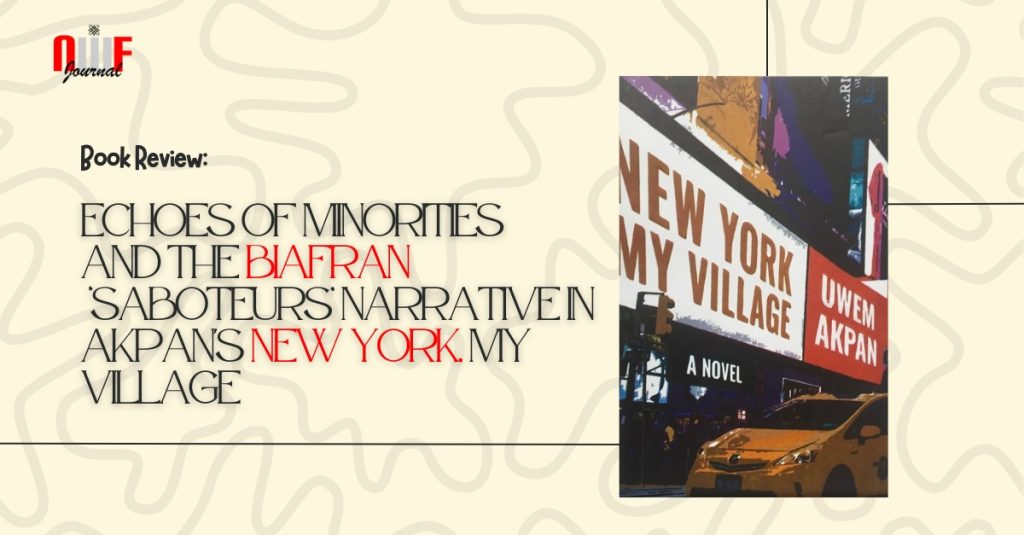
“NOTHING WAS GOING TO STOP ME FROM ENJOYING NEW York to the marrow,” opens this novel that takes the form of a travelogue, “as we say back home in Ikot Ituno-Ekanem in the Niger Delta of Nigeria.” However, the challenges of racism, the nameless animosity between Africans and African-Americans, rent racketeering, and bedbugs would soon make Ekong Udousoro, Akpan’s subjective narrator, to be homesick a few days after his arrival in New York. In the Acknowledgments, Akpan says he wanted to give Nigerians a shocking revelation about New York by talking about its bedbugs, one of the antagonists that Ekong faces in his sojourn in the city, but Teju Cole has done that already by giving bedbugs’ terrorism in New York a spotlight in his Open City. And Akpan is right, the revelation of vicious bedbugs in New York City came to me as a shock in that book. Perhaps what Cole didn’t tell readers in his book that Akpan mentions here is that dirt is not what invites bedbugs to people’s homes.
“And to Uwem Akpan and Samuel Kolawole,” writes Chika Unigwe in the Acknowledgements of her acclaimed The Middle Daughter, “for letting me rant when I’ve needed to,” is perhaps my first encounter with the name of this ex-catholic priest and mighty Nigerian writer. When the poet and critic, Paul Liam, posted on Facebook about the reading of a book moderated by the quintessential Richard Ali in Abuja on the 12th of July, I found the title–New York, My Village–catchy and humorously promising. And when 11 days later it was longlisted by the NLNG Nigeria Prize for Literature, I knew it simply had to be the next Nigerian novel I would read.
So, do we have a rival to Alain Mabanckou when it comes to dark humour? That was the question I asked myself after reading the first two chapters. I couldn’t contain my excitement; I had to trumpet this book to nearly every literary faithful in my circle, urging them to spare the time (and the fortune) to witness Uwem Akpan’s magnificent offering in the great shrine of Nigerian literature.
In our Flame Tree Writers WhatsApp group, my friend Hussani Abrulraheem mentioned that Uwem Akpan had written his all-time favourite short story, “My Parents’ Bedroom“, a winner of the Commonwealth Prize (Africa region) and a Caine Prize shortlist. He shared a link to the story, which I read the following day. I was thrilled to discover Akpan’s singular skill for narrating stories through the eyes of children. The character of 8-year-old Ujai in this novel was already impressive, and here I was reading 9-year-old Monique recounting her experience during the Rwandan genocide. The story also highlighted Akpan’s longstanding commitment to amplifying the voices of minorities. I discovered that beyond the well-known Hutu and Tutsi, there is also the Twa people in Rwanda, a group often overlooked.
Now 54 years old and with just two books to his name, a collection of stories and a novel, published 13 years apart, I have a feeling that Uwem Akpan may become Nigeria’s answer to Juan Rulfo, the great Mexican author of El Llano en llamas (collection of stories) and Pedro Paramo (a novel). In defence of Rulfo, Susan Sontag has argued that the purpose of a writer’s career is to write at least one great book, and not to go about writing and writing.
After leaving his post as a literature lecturer in Uyo, Ekong now works as a managing editor of Mkpouto Books. He is currently in the United States on a four-month Toni Morrison Fellowship for Black editors at Andrew & Thompson, where he is understudying their operations. Ahead of the 50th anniversary of the Nigerian Civil War, he will also use this opportunity to edit an anthology of stories by minority writers on the Biafran War. This project is a direct response to Chinua Achebe’s contentious war memoir, There Was a Country, which portrays these minorities as supporters of Biafra and sanctifies Ojukwu, a narrative the anthology sets out to challenge. As Akpan’s narrator explains, “This ethnic war rang deep in my soul: I was born a year into it, in 1968, hence my mother naming me Ekong, which means ‘War.’
Achebe’s There Was a Country insisted that Biafra fought the civil war over their right to self-determination. This novel argued the minority ethnic groups within Biafra were denied the right to the same thing Biafra went to war for.
When I described this novel as “sublime” in a social media post, an Igbo friend retorted, “This book is unfriendly.” In reply, I quoted Ta-Nehisi Coates, “literature is anguish.” I reminded him that we read to receive its ultimate gift of enlightenment. This exchange took me back to when I first read Chimamanda Ngozi Adichie’s Half of a Yellow Sun. I was not happy with her portrayal of Sir Ahmadu Bello’s final hours at the hands of Nzeogwu, where he cried “mmeh mmeh like a goat,” begging for his life. I called the friend who had recommended it and declared I could not continue, feeling it was a profound mockery. He urged me to press on, advising me to be open to variant recollections of narratives. I took his advice and finished the book. Today, despite its contentious nature, it remains my favorite Igbo-authored account of the Biafran story.
In the first chapter, Akpan unravels the bullying that Nigerians receive in their own land in the hands of American embassy officials during visa interviews. People are asked a few random questions out of which incriminating conclusions like “you are not going to return” or in the case of good looking women, “you are going there for prostitution” are drawn. For Ekong, saying he doesn’t belong to any of the major ethnic groups in Nigeria, and that his tribe is called Annang in the Niger-Delta, a Nigerian tribe the embassy official has never heard of, was enough to deny him visa into the United States. It took the intervention of a Congressman to write to the embassy in Lagos to let him travel to America. The humiliation at the embassy in Lagos is so tense that people openly jubilate successful applications. But the embassy is just the beginning, upon arrival, there is also the ICE (Immigration and Customs Enforcement) to deal with.
Like General Philip Effiong, Ojukwu’s second in command who was of Ibibio stock, every minority who stood with the Biafrans was a sell-out, a traitor in the eyes of Biafran minorities. Ekong’s kinsmen believed his decision to marry Caro, a granddaughter of a traitor, was flawed. They felt Caro’s big “front” and “back” deceived Ekong into marrying her despite the unforgivable atrocities of her grandfather against the clan during the war. Caro’s grandfather spied for the Biafrans in reporting suspicions of sabotage, which led to the death or disappearance without a trace of many.
Like the island of Gorée during transatlantic slavery, the Annag-Igbo border was also a point of no return for Biafran minorities. Thus, an intergenerational malice was sustained between the clan and Caro’s family. There was a silent agreement between Ekong and Caro to never discuss the war between them. It was, as Ekong narrated, a no-go-area.
Usen Umoh is Ekong’s childhood friend. He lives with his family in the Bronx. His wife, Ofonime, lives with the trauma of being labelled a prostitute at the American embassy in Lagos during her visa application. He has a bad temper against the Igbos and back in high-school he stabbed an Igbo boy. His daughter, Ujai, who instantly establishes a strong bond with Ekong is living with the difficulty of being a black kid in America but finds solace and pride in the fact that she is African with a home in Ikot Ituno-Ekanem, but her parents live with the fear of her finding out that in Nigeria too she’s a minority. Akpan alludes to a strong connection in this book between the Annangs living in Nigeria and those in the diaspora.
Also in New Jersey is Tuesday Ita, who left Ikot Ituno-Ekanem in 1975 and never returned, but his charitable interventions are noticeable everywhere in the village. Ekong encounters a segregated Catholic community, divided into separate churches for blacks and whites congregants in New Jersey. Tuesday, who had enough of the bad blood between Africans and African-Americans, goes to the ‘white catholic church’. But he needed to transform into a white man. He changes his name and when Ekong sees him, all he could think of was the frightening transformation of Gregor Samsa into a giant bug in The Metamorphosis. He only identifies him by his ability to speak faultless Annang. Tuesday Ita is now a white man. “Call me Hughes and nothing else, please!” is the instruction he gives to Ekong.
The civil war consumed the Itas. Only Tuesday survived. The Biafran patrols targeted him when he was ten-year-old for conscription into the Biafran army following a tip off by their Igbo neighbours after a quarrel between his mother and them who, as we read in chapter ten, boasted they were the owners of Biafra. The quarrel deteriorated when Mrs Ita lashed out that “the dog that barks at me is usually devoured by the lion,” meaning bigger bullies—the Yorubas and Hausa-Fulanis—were coming for them. Tuesday was saved from rape and potential murder in the hands of the Biafran patrols by Father Walsh, an Irish priest in Ikot Ituno-Ekanem. There was a belief that since that incident Tuesday fancied the idea of becoming white after the caucasian saved his life that his fellow blacks were determined to destroy.
When Ekong arrived at the church in New Jersey for a thanksgiving over his successful trip to America at the insistence of Tuesday, he met a priest they called Father Orrin outside greeting his white flock. All attempts by Ekong to greet the priest failed as the white man refused to acknowledge his presence until the arrival of Tuesday. Ekong recounted, “Yet, each time a family went away and I got my smile ready and stepped forward, he grabbed the next family and next woman and next man and next child, or even the next tree. It was like there was a bone in his neck that prevented him from turning in my direction, much less seeing me.” They were later joined by Usen and his family.
Inside the church, while sitting, an usher sidled up to them and asked them to move to the columns of outer pews, away from the central position they occupied. They refused. Usen was particularly fierce after one of the ushers described their refusal to be shifted to the corners of the church during the Mass as “sabotage,” the very word used by the Biafrans as the excuse to persecute his fathers and would lose his fuse to the level of using the f-word in church. His agitations calmed the situation, the ushers backed off and announced to them that Father Orrin would love to meet them in a private sacristy reception after Mass, to personally apologize. While holding Mass, Father Orrin mistook the Annangs in his church for Igbo and made some racist and antisemitic slurs, accusing the Jews of killing Jesus Christ and questioning why the Igbo were aligning with the killers of Christ, instead of the catholic church that supplied them with aid during the war.
To their shock, Father Orrin confirmed to them in the private sacristy reception that he sent the ushers to move them from where they sat but later asked them to stop, probably after realising that Ofonime was filming the drama. He unequivocally asked them to never return to the church because they were blacks. I felt writing about Ekong’s visit to New Jersey, as a catholic priest, was probably the most difficult part of the book for Akpan to write. Here, Akpan couldn’t tell the story humorously. He penned the incident with raw and undiluted emotions. Ofonime had to slap her husband to calm him. When they came out of the private reception, a lot of whites in the church genuinely greeted and socialised with them and they took pictures smiling and cheering. Upon realising that Father Orrin called the police for them, and the police were driving after them when Usen was to drop Ekong at the train station, they were so terrified that none of them thought of coming out of it alive.
Personally, I feel the way Father Orrin ignored Ekong in his church when he arrived, is the way Akpan ignores the struggle of Palestinians in this book. A post pandemic unprovincial literature that historically interrogates violence and discrimination—which even has a place to decry antisemitism—but ignores the Israeli occupation of Palestine leaves the reader with no choice but to suspect religious bigotry, especially when the author is a catholic priest. Perhaps, if only Palestine was a catholic nation, the author would have delved into the conversation on how Israel becomes a conquering progeny of a conquered ancestors using the tools of violence and discrimination.
The racist incident at the catholic church in New Jersey reaches home through Father Kiobel, the priest in charge of Our Lady of Guadalupe, the catholic church in Ikot Ituno-Ekanem. The town was agitated. The youth demanded “equal and mutual and reciprocal” banishment of white parishioners from Our Lady of Guadalupe who are oil workers in the town for peace to reign. The Awire womenfolk, a formidable pressure group in the town, threatened to come out nude and protest the racism in the church incident.
Everyone loves Father Kiobel, an Ogoni man whose father died during the war attempting to stop mob in Sokoto from lynching their Igbo neighbours during the pogrom. The only issue is his embroidery and frills that drive parishioners to complain that the man cannot stop buying clothes. We would learn towards the end of the book that his obsession with new clothes is a psychological hangover from the civil war. For looking at an elderly Biafran soldier in the eye when he was eleven, after bravely stopping the soldier from sucking his mother’s boob near the market in Aba, both him and the mother were stripped naked and paraded as mad people in the market. Since then Father Kiobel couldn’t have enough clothes for himself.
The central leadership of catholic church intervened and punished Father Orrin only but for his antisemitism because there was no evidence or witnesses to testify his racism, the whites in the town appeased and apologised to the people, and Ikot Ituno-Ekanem was consoled. Father Kiobel used the door opened by the reconciliation to tell his Biafran war story that everyone was dying to listen in the town. Halfway into it he was overcome by tears and later the church announced that it was holding a war memorial for people to come out and tell their war stories so as to heal and move on from it. This development coincided with the rumours making rounds that Tuesday was now a white man. Tuesday accused Father Kiobel for spreading the rumour and vowed to use his money and influence to sabotage the planned civil war memorial.
Ekong initially believed Andrew & Thompson was a cosmopolitan workplace. However, he soon discovered he was surrounded by racists after overhearing a colleague describe egusi as “vomit” and call him unprintable names behind his back. In a twist of irony, the very people in his apartment building—his white, Chinese, and Latina neighbors—whom he had suspected of racism, became his true friends.
One misinformation in this novel is the claim by Akpan’s narrator that the government banned history in our schools to conceal the past from the Nigerian children. At no point in time did the Nigerian government ever ban history from our curriculum. We love sharing blame. What Akpan ignores in this book is that even the systematic attempt to remove history from our curriculum happened when his fellow minority from the Niger-Delta was the president; when the ministry of education merged history with social studies and government in secondary schools. This decision was influenced by Nigerian public sentiment that prioritises sciences, technology and vocational studies in our schools. Ayobami Adebayo aptly captures this in her Booker Prize shortlisted novel, A Spell of Good Things. Busola’s father couldn’t find another job after his retrenchment by the government as a history teacher in public school. He would blame himself for not studying sciences because history was not demanded in the labour market.
History is not thriving in our schools, not because the government banned it; such a thing like banning history in our schools has never happened. History is an endangered discourse in our country because of the prevalence of philistinism among our educated class. Education is widely not seen as a source of enlightenment first, but as a source of meal ticket. We live in a country where education is proudly described as a scam because of the unemployment rate among young graduates. Even fiction is not spared. A significant portion of educated Nigerians view it as a frivolity. Courses in our higher institutions are classified into marketable and non-marketable. Sadly, history falls into this non-marketable category and hence the “rational” reason to avoid it. This reminds me of when I had to convince some relatives of its economic potential before letting their daughter study law. Yes, law!
History was taught in my high school senior classes till the day I graduated in 2009. And when I returned nine years later to serve there as an accounting teacher in 2018 during my NYSC, it coincided with the time that Buhari’s government made history compulsory in junior secondary classes and in 2022 this policy was extended to primary schools. So when exactly did the government ban history in Nigerian schools?
There is a profound omission at the heart of Akpan’s otherwise contentious novel: the experiences that drove non-Igbo minorities to fight for Biafra. The book leaves a significant gap here. Chigozie Obioma has illustrated this dynamic in his The Road to the Country, a Calabar man is moved to join the Biafran cause after witnessing trainloads of the dead returned to Enugu. The motivations of characters like Caro’s grandfather to side with the Biafrans and historical figures like Gen. Philip Effiong deserve a place in this story, as their presence deepens our understanding of the war’s complex loyalties.
Nevertheless, this novel is tender, unprovincial, and unsettling. Alternating between anger and laughter, without mincing words, New York, My Village is a stellar performance from Uwem Akpan; a successful marriage between art and polemics; and a love note to minorities and their struggles.