

So You Want to Read for Free?
Mar 22, 2026

Literary journal of the Northern Writers Forum.







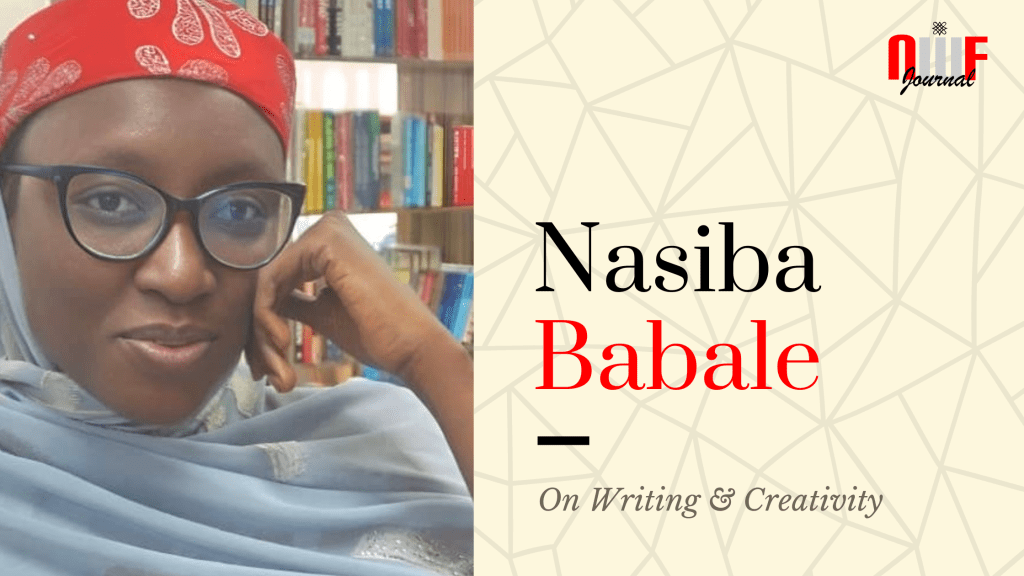
Nasiba Babale is a poet, medical laboratory scientist, and Creative Director of Poetic Wednesdays Initiative. Author of Pickled Moments and The Rain Is Like You, her poems move like light through quiet rooms—grief folded into metaphors, identity humming in everyday speech, and love lingering between question marks and full stops. In this conversation, she speaks of accent wars, grief, the science of unstructured writing, and why she’s made peace with the blur between “pish” and “fish.” A poet who never begs for attention but always earns it—The Poet of Light, for a reason.
You’re welcome, Nasiba, I appreciate you agreeing to do this for us. Your poetry carries an unmistakable voice rooted in identity yet fluid in its exploration of themes. Do you think a poet ever truly finds their voice, or is it an endless search?
Well, you didn’t act like no was an option. I had to get you off my back. I think the poet is on an endless journey, and as he moves, he picks up and drops voices on the road. Each voice is distinct in its pitch and tone, but all of them belong to him.
I try to blend personal truth and poetic imagination into a perfect smoothie. Too smooth for anyone to tell the fruits apart (or so I think).
How do you navigate the fine line between personal truth and poetic imagination? Do you feel exposed when people read your work, or do you hide behind the beauty of language?
Yes. I feel quite exposed. I try to hide behind words. Though a good friend told me I am not doing a good job at it. For someone who is reserved, I don’t fully understand how I got myself into the business of writing in the first place. And not just writing, writing poetry. So I try to blend personal truth and poetic imagination into a perfect smoothie. Too smooth for anyone to tell the fruits apart (or so I think). Yet, I read some of my poems and still fear that I have made myself too vulnerable. Too open for all to see (I hope the world is as blind as I think it is).
Do you approach writing poetry with the same discipline you apply to science, or is poetry your escape from structure?
I don’t think there is any discipline in my poetry. I am barely a scientist when I write. I am just a human trying to let go of some things, or just trying to play with words. There is no Standard Operating Procedure when I write. No Job Aids. No quality control measures I need to take. And no boss I have to answer to. It is just me and words. And freedom.
If poetry is how you make sense of the world, what is something you still haven’t been able to put into words?
Grief. I have written quite a lot about loss. And the sadness that comes with it. But every time I go over them, I feel like the words do not match the emotions. Maybe grief is too heavy for words to carry. Or maybe my pen is not strong enough to carry it.

Was there ever a time when you were at war with your accent? Your poem “How I Wear My Accent” in Pickled Moments, speaks to the tension between authenticity and societal expectations. What moment in your life made you fully embrace your voice, accent, and linguistic identity?
I was at war with my accent. I didn’t try to sound American or British, though. I just didn’t want to be the Hausa girl who interchanges p and f. I grew up seeing people laugh at us for the way we say fiful and pish. How it is associated with illiteracy and a lack of sophistication. I wanted to be so far away from that. So distant that when I speak English, no one gets to pick up traces of my ethnicity. I learned how each word is pronounced and gave special attention to the ps and fs. Until one day at the laboratory in NYSC camp, a colleague kept on going on and on about how I speak very good English for a hausa girl, how I do not mix my ps and fs like my people do. And it dawned on me that it wasn’t a compliment. That accents aren’t symbols of illiteracy or a lack of sophistication. They are identities. Kind of like tribal marks. And I vowed never to pay special attention to the ps and fs. Let them go wherever they want to go.
There’s a whole section in the collection that blends persona narratives with reflections on war and tragedy. How do you hope readers interpret and engage with these parts?
I do not put too much hope into how my readers interpret my work. They are hardly on my mind when I write. All I hope for is that someone feels something when they read me. I just want to evoke feelings. How they do that is something beyond my hopes.
Looking back on the journey of creating this collection, what moments or responses have affirmed the impact of your work on readers and the literary community?
I love it when a random stranger whose existence I never knew of reaches out to me to say they read a particular poem in the collection and they could relate to it. It makes me happy. The fact that someone has read my poem and felt less alone.
Was your chapbook, The Rain is Like You, difficult to write emotionally? Were there poems that made you hesitate because they felt too raw, or too revealing?
I didn’t write a chapbook. I wrote poems that somehow, found themselves in a chapbook. Each poem was written individually, with zero thoughts of them being in a collection. When KSR reached out to me requesting ten poems to publish in the chapbook, I couldn’t decide which poems to send. Not because I was worried some poems are too raw or revealing, but because I couldn’t decide, and I didn’t want to be biased. So, I sent the poems to Carl Terver and he chose the ones that made it to the collection.
You’ve expressed both fascination and disillusionment with love. Is love truly a scam, or is it simply the most misunderstood concept in human history?
I don’t know what love is. Not anymore.
As someone who appreciates good language, what makes a poem unforgettable to you? Is it the depth of meaning, the choice of words, or something else entirely?
I think it is mostly a mixture of both. I love poems that convey something profound in a very simple, very casual kind of way. Those poems that sound so ordinary from the beginning but leave you giddy at the end. I love poems whose words are so perfectly laid out, so well aligned that you know the poet took their time handpicking them. Those are the poems I don’t forget.
If a stranger were to discover you through a single poem, which one would you want them to read, and why?
‘My Mother Said I Came on a Day Like This’. I would want them to read it. I feel like the poem is my bio.