

So You Want to Read for Free?
Mar 22, 2026


Literary journal of the Northern Writers Forum.





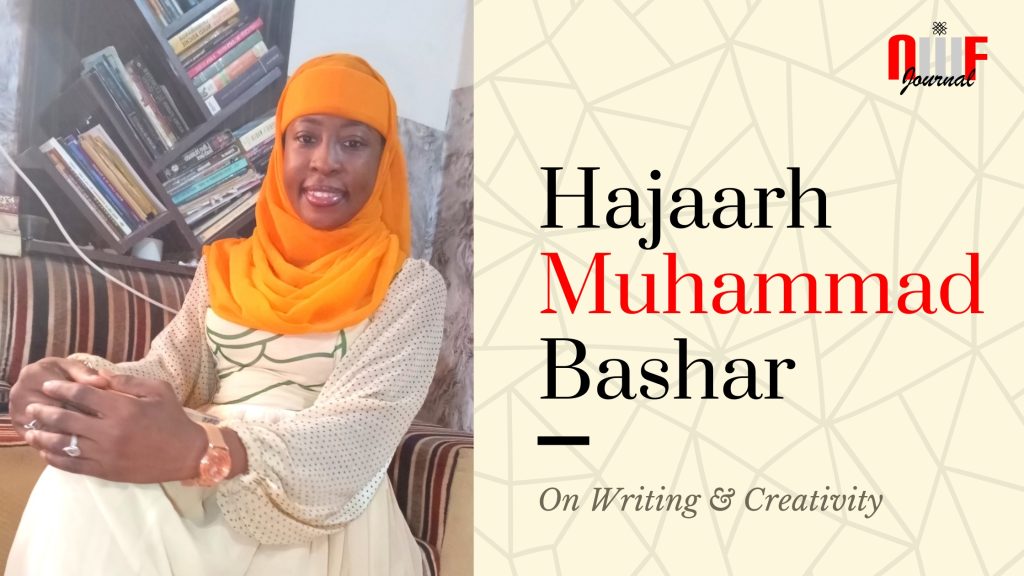
Hajaarh Muhammad Bashir writes like someone who has lived many lives in silence and decided to speak only when it truly matters. Her words carry such tenderness and tension, humor and heartbreak, often all in the same breath. She is the winner of the TYBLI Young Adult Literature Prize (2024), The Nigerian Prize for Indigenous Language (2023), The GentiMedia Pidgin English Writing Competition (2023), and the Hafsat Abdulwahid Women Prize (2022)—among others. But beyond the awards, it’s the intimacy of her storytelling, the honesty of her voice, and the quiet power of her perspective that leaves a lasting mark.
You are welcome, Hajaarh. And thank you for the honor of this interview. You go by the name Huntress, that’s bold, a little dangerous, and definitely unforgettable. Has adopting that identity shaped the way you write, the way you move through the world, maybe even the things you allow yourself to feel?
Yes, it has. The name felt personal and connected to me when I first came across it in ‘Bird of Prey’. The character and personality of Huntress was daunting, strong and resilient. It found me in my most vulnerable moments and I thought It was the best identity I can adopt to navigate the challenges I was facing at that moment and for the future. And it did help. How it shaped the way I moved through life and through things I felt was what made me the writer I am today.
Your work is laced with beauty, rage, and the kind of haunting calm that follows you like a shadow. When did you first realize writing was not an option, but a necessity?
I have always been very passionate about writing. I wrote my forthcoming novel from ending 2017 to beginning 2019. Once I started, I did not stop until I completed it and that was my proudest accomplishment at the time.
But I think I realized it was a necessity during Covid 19 lockdown. All I did during that period was teaching my siblings by revising their subjects and going deeper into the topics, and writing. By the end of that period, I had completed another manuscript. That was when I realized I could only truly breathe through writing.
Interesting! When’s the first time you wrote something and had the audacity to believe the world would have to listen?
That should be when I wrote my essay about identity. Thinking back to when I was writing that essay, I felt it was the perfect way to scream out what was in my mind and have the world listen.
You wield languages, switching between English, Pidgin, and Hausa like it’s a superpower. What language do you feel most comfortable in and what determines the language the reader gets to experience?
Well, I feel most comfortable writing in English because the words come almost naturally, unlike when writing in Hausa or Pidgin that I have to be very deliberate about it. And I think the story determines what language I write in. For example, there is a historical hausa fiction I started writing. When the story came to me, I felt this story would be best written in Hausa, perhaps because of its structure and plot.
Back when we were writing about cats and love on Facebook, what was it in those scribbles that still haunts you? What made you a writer before you even knew it?
Haunt is quite a strong word. Before I started writing about cats and love, I was already a writer; a prose writer. I started writing for quite a long time before I even frequented Facebook. The days of cats and love were days I ventured into poetry that became a hobby. When I was in my final year in 2016 during my undergraduate program and doing my project practical work, I was writing in the laboratory. It was like I was switching between two worlds and I enjoyed it. One minute, I would be performing serial dilution and striking my petri dishes and the next minute, I would be writing once my petri dishes were in the incubator.
So, I was already a writer and the beginning of my writing dates farther back before 2016.
Do you think your art would be the same if you experienced sound like everyone else. There’s a certain depth to your writing that feels like it’s been filtered through a world less cluttered by noise. Is that clarity something you’ve grown to embrace, even as the world rushes to fill every quiet space?
I’m not sure. I could never even imagine how my art would have been if I was experiencing sound like everyone else. I think I wouldn’t even be a writer at all. I was very passionate about becoming a lawyer when I was hearing and I would have dug into that. After I experienced silence, I was obsessed about becoming a scientist in the chain of Maria Curie and others. Thankfully, I am a scientific officer now. Art found me before I realized it and it was as young as I was back then.
I was once asked a question during the reading of my winning pidgin short story on X space. The question signified that the story felt too real as if I had written about something that truly happened and the questioner asked me how I get inspired to write stories that feel real. I think this question I was asked is similar to what you are asking me.
Even as the world rushes to fill every quiet space, there is clarity and depth in my writing because my eyes have become the ears that hear and see through the depth in every life out there. I may not completely understand what you mean by ‘as though it has been filtered through a world less clustered by noise’, but I will like to say that I feel just as much noise as people hear when I observe people out there. People’s actions scream and it’s so loud.
When you come across a group of people talking and laughing or fighting and cursing, the first thing you’d automatically do is to listen through their words to know what they are talking about or why they are fighting. But the first thing I would do is listen to their actions, my eyes would read their body language and see what the mouth is not saying. I try to adopt things I observe deeply and give life to words. Thus, my characters and writing feel real because my characters are humane, and my writing has life.
“I look at a mechanic and beneath his hard work, I see his sweat-bathed flesh, wrinkled brows, tired expression and desperation, and then I try to conjure a possible backstory of his life”
How has your unique experience of sound, or silence, become a tool in your writing arsenal? Your words linger. Does that come from being attuned to the subtleties around you?
Yes, it does. I write best when I am among people. Like my answer to your previous question, I try to see more than people offer. I am very observant and I thirst for those subtleties that are not easily seen. When I want to get inspired to write a story or when I seek an element to add to a story, I simply drown in my hijab and walk out of the house, down to the loudest part of the street or to a mini-market, where a story is hidden in every action.
I look at the mechanic and beneath his hard work, I see his sweat-bathed flesh, wrinkled brows, tired expression and desperation, and then I try to conjure a possible backstory of his life. I once wrote an essay by simply watching a boy walk down the street. It wasn’t just about him walking down the street but about the subtlety surrounding him as he walked. The essay is still new, so I haven’t submitted it yet.
I believe everything is interconnected in life and human actions. There are things you simply relate to by just watching. The lack of hearing gives one the opportunity to see beyond the mundane. Just like how the ears become a superpower for the one who cannot see.

Your writing always carries so much force and feeling. When you’re really deep in it, how do you tell the difference between simply expressing yourself and truly exposing something personal?
This can be explained in two ways. It is easier to tell when you’re writing an essay/creative nonfiction. Recently, I started writing a memoir that was inspired by the theme surrounding Cassava Republic’s call for women prize for creative nonfiction. They wanted a creative nonfiction that bridges the gap between creativity and theory.
I was interested in trying something like that, so I began to write a manuscript of creative nonfiction surrounding topics on women. It is like a collection of memoir and the topics ranges from racism, gender discrimination, patriarchal dominance, marital violence, reproductive health issues, rape, feminism/femininity and more. Among these essays, there are those that feel deeply personal in ways that I have experienced and felt the stings of these issues that revolve around silencing women as a societal stigma or cultural norm. In those, I am exposing.
There are others that may not be too personal but I can relate to them mainly because I have witnessed someone close experience it and then I begin to write to express my stand on that topic. This is what I would consider expressing.
I hope that answers your question.
That is fine, thank you. What’s something you wrote that you still feel vulnerable about? Something you wish could be hidden but can’t ever be erased now?
There are two nonfictions I wrote that I still feel vulnerable about. Sometimes, I feel relieved that these nonfiction were published in closed anthologies. Hahaha. Most of my works are largely published in anthologies.
One of the nonfiction was featured in Bakwa magazine, which is a pay to read magazine, and the other was in the Weight of Years Anthology of Afro-anthology creative nonfiction – I don’t know if the anthology is still downloadable online. Those two essays felt like raw exposure of myself.
You’ve written some raw truths about identity, silence, and existence. But here’s a gut-punch question: When was the last time you felt misunderstood as a writer? And how did you handle it?
I don’t think I have gotten there yet. But I have a feeling it will come soon because what I am working on these days could lead to such controversies and misunderstanding.
But here is a premonitional answer from my future self on how l will probably handle it:
I have always understood and accepted that once a story, in whatever form, leaves the writer’s hands, it no longer belongs to the writer. It belongs to the audience and how it is understood by them cannot be helped.
Many writers in the history of time have been misunderstood. The major thing a writer should be concerned about is if he/she has fulfilled his/her responsibility as a writer.