

So You Want to Read for Free?
Mar 22, 2026

Literary journal of the Northern Writers Forum.





About The Writer
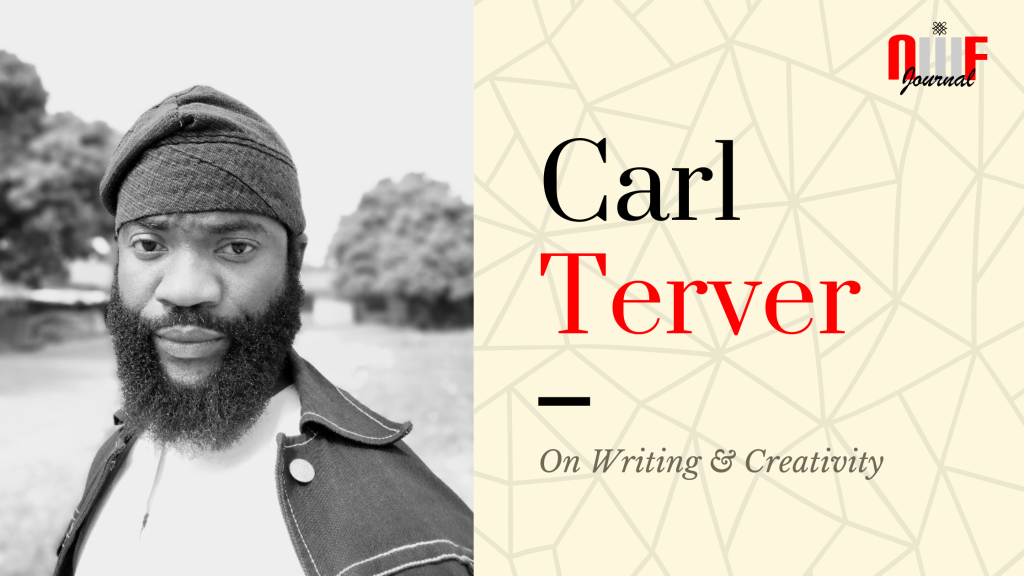
Carl Terver holds a BA in English from Benue State University, Makurdi. He is the author of For Girl at Rubicon and the photobook Glory to the Sky. A noted style critic, he writes about film, literature, photography, and music. His work has been published in The Stockholm Review, Goethe-Institut Nigeria, and Afapinen. In 2024, he was longlisted for the Commonwealth Short Story Prize. He is currently the Digital Editions Editor at Konya Shamsrumi.
It’s a pleasure to have you grant us this interview. Let’s get to know Carl Terver beyond writing and criticism—who are you outside of literature?
Terver was born in July 1991 in Omotayo Hospital, in Ikeja, Lagos and completed his primary education at The Rock of Ages Nursery and Primary School, Akowonjo, Lagos. I attended Federal Government College Vandeikya, spending just my JSS1 there before going on to a missionary secondary school in Zaki-Biam where I completed my secondary school education. I have a BA English from BSU, Makurdi. I am of Tiv ancestry of the Tiv people who settled, after many years of migration, in the Benue Valley in present-day North Central Nigeria.
You write so beautifully. What drives you to write, and what sparks your creativity?
What drives me to write is simply the wonder of my limitless consciousness, which manifests as an artistic response—something I believe all humans have. I always wanted to be an engineer but the universe had different plans.
I mourn that I cannot know what kind of creature humans are going to become in the far future. I love music. And I like quiet.
And how did your upbringing shape the writer you’ve become?
To think about how my upbringing shaped my being a writer, there’s too much to recount. But I know having access to books early on was a major influence. I play chess. I have an interest in quantum theory, space science, evolution, and the evolution of humans. I mourn that I cannot know what kind of creature humans are going to become in the far future. I love music. And I like quiet.
I am not responsible for what label I am given as a writer, as long as it doesn’t incriminate me. Everyone needs a way of—or will find a way of—categorizing you.
The term “Northern Nigerian writer” often comes with assumptions—both within and outside the region. Do you embrace this label, resist it, or redefine it in your own terms?
I am not responsible for what label I am given as a writer, as long as it doesn’t incriminate me. Everyone needs a way of—or will find a way of—categorizing you. It’s merely the scientific instinct in all of us at work, a survival skill we have had for a long time, which has helped us through understanding the world and knowledge production. Talk about the classification of living things in biology, for example. So, Northern Nigerian writer, what does it mean? Just let your work be outstanding. Let the classifiers classify.
Your poetry and essays often explore contemporary Nigerian life with a sharp, critical lens. Do you see yourself as a social commentator through your work?
I am a student, not a commentator. The latter feels like a job. I study life, art, human behaviour, social and cultural dynamics, and all. My writing is therefore to put forward my thoughts on all these things.
Your literary critiques and discussions often carry a high standard that some might call elitist. Do you think literary discourse should always maintain a certain standard, or do you believe there’s room for more accessible, diverse ways of engaging with literature?
We may not admit it but the best art is elitist or has to be. Because we are only able to know what’s not best by comparing it with the standard. And to know the standard is to judge if it is elite. I know I am likely going to be misinterpreted on this. But fine, let’s fight.

For Girl at Rubicon has been described as deeply personal and evocative. What was the emotional or intellectual state that led to its creation?
It was unrequited love, nothing else. The poem was very spontaneous, in the very Wordsworthian sense, as the verses began as responses posted on Facebook after I’d been stood up by this lady I was so in love with. (It sounds funny now because I can no longer locate that romantic animal I once was.) I had been trying to get her love me back. And that day I reached threshold. I practically composed the poem as several Facebook posts before a friend, Emmanuel Oluwaseun Dairo, messaged me about how cool he found the lines. So I looked at the several posts and saw that, oh, that’s not a lie. I copied them and put in MS Word. And the rest is history.
Many writers struggle with discipline. How do you balance writing poetry, fiction, and essays while maintaining your distinct voice in each form?
I am just lucky. And I may say it’s because I only write what needs to be written. This way, all of the writing comes natural, and the varying poetics they function in take over.
As an editor, you have an eye for detail and structure. How has editing other people’s work shaped your own writing?
A lot. Editing taught me how to listen to what I am writing. I think the biggest takeaway I have learnt from editing, as pertaining the art of writing, is the art of euphony. Know this small secret and your writing will greatly improve.
What’s the most challenging manuscript you’ve ever edited, and what did it teach you?
No manuscript has challenged me yet.
How does it feel to have edited The Incredible Dreams of Garba Dakaskus, especially now that it’s on the longlist for the 2025 Dublin Literary Prize? Did you have a sense, while working on it, that it was something special?
I already reviewed The Incredible Dreams of Garba Dakaskus; weird, since I edited it, not so? And because of this fact, I approached my review very differently, and I think that review already answers your question of what I think about the novel. But to indulge you, I’d say, yes, the novel has moments of enchantment, but not very many, personally for me. What I loved about it, whilst editing, is the feat that Sidi accomplished what he sought to execute while writing the book, in not just making The Book the setting of a novel, but in painstakingly making sure that the labyrinthine plot disperses but still connects so that it is a complete work onto itself. I must tell you though, that I do not give in to all the craze about it, but this is because of my preferred taste for fiction. However, it is a very important novel at the moment because of the discourse it shall spur—you will see this very soon—which I think the writing community needs right now. I think it has a very wonderful title. Congrats to its Dublin Literary Award longlisting.
Your most recent book, Glory to the Sky moves beyond text into visual storytelling. What inspired this transition from writing to photography?
I am not yet a photographer; I only write about photography, some of which I take sometimes.
What is the link between poetry and photography? And how do they complement each other in your creative process?
I’d say since both are art forms, that’s their link. Photography is very direct and visual, while poetry aims for evocation and subtlety. But both are evasive. For photography, it is the fact that you may look at it and see nothing, or that you can miss what it wants you to see. But this is not so straightforward, because how can you tell what a photograph wants you to see, (1) as the photograph itself, and (2) as what the photographer wants you to see? Roland Barthes already asked and tried to give answers to these questions in his book Camera Lucida; as I have also done in my essays on photography, “The Lessons of Hue Editing,” and “An Affordance.” In a similar way, poetry, while it may not have such palindromic problems or pose such paradoxes, it demands its own kind of wit for readers to catch it. Ultimately, both forms—poetry and photography—demands our ways of seeing and perceiving to change, be altered, or maybe even heightened to sensitivities we are sometimes blind to. This is good. Therefore, the poet and photographer owe us this fidelity. I don’t think my poetry and photography need to complement each other in my creative process, because I do not know how that works. But I believe my words here give a little extrapolation on this.
Thank you once again!