

So You Want to Read for Free?
Mar 22, 2026

Literary journal of the Northern Writers Forum.




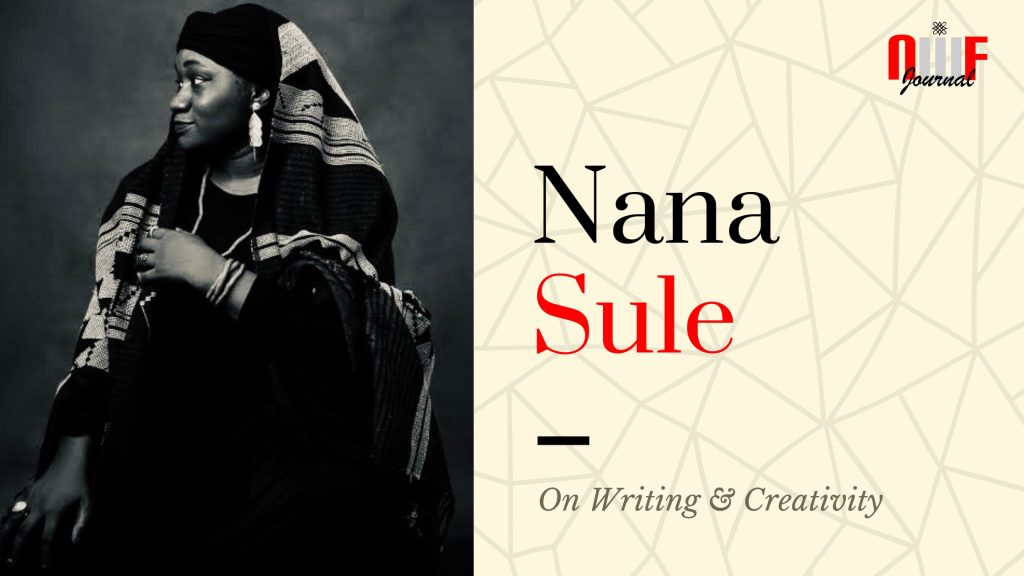
Nana Sule is a writer, journalist, and communications strategist. She curates literary events and co-owns The Third Space, a bookstore and workstation in Kano. Her works have been published in Agbowo, Isele, and Arts-Muse Fair. She was the first runner-up for the 2022 Alitfest Prize for Fiction and was longlisted for the 2023 Sevhage Prize for Fiction for her short story, Owanyi. She also won the 2024 Eugenia Abu/Sevhaage Prize for creative non-fiction. Her forthcoming short story collection- Not So Terrible People- is set to launch in the second quarter of 2025. Nana crafts stories that feel familiar yet are imbued with the unexpected. She also indulges in a love for chocolate and suya.
Welcome, Nana! Thank you for agreeing to do this with us. You have a distinct voice and a unique approach to storytelling. Can you walk us through your creative process, how do your stories come to life?
It’s entirely my pleasure.
And what a compliment—that you think I have a distinct voice and a unique approach. Haha. Thank you!
Honestly, there isn’t much to it. First, a story grabs me by the throat and refuses to let go until I carefully unwrap its hands, take them in mine, sit it down and ask, “Okay, what are you on about?” From there, it’s mostly listening and plotting, but all in my head. A lot of my writing lives in my head long before it ever touches the page.
I sit with the idea, eat with it, sleep with it. I let it marinate into my bones until I understand where the story starts, but most importantly, where it ends. I almost never begin writing until I have a clear sense of the ending I’m working toward.
Once I have that, I move into research—especially if the story includes characters or experiences that are outside my own. At that stage, I usually try to get an accountability partner, because I have a tendency to get lost in research and just stay there.
Then comes the writing, which, surprisingly, is the fastest part. I can write anywhere—on my phone, in a notebook, in a tricycle—because by then, it’s like copying from notes I’ve already written in my head. Of course, things shift. New characters pop up, ideas sneak in. And that’s okay. I allow the story to evolve, but I try to write the full first draft without editing as I go.
Once the draft is done, I let it fallow. I give the story time. Sometimes a long time. Like the second story in my forthcoming collection, Not So Terrible People, the first draft of Owanyi was written in 2014/2015, and yet here we are.
After that, it’s just editing whenever it calls me. Because once a story has found life on the page, or on a keyboard, it finally lets go of my neck.
Speculative fiction isn’t exactly mainstream in Northern Nigeria, especially for women. Being the first Northern Nigerian woman to venture into speculative fiction, what has been the most surprising part of your journey in this space?
Yeah, I also noticed that there weren’t many women from Northern Nigeria in the speculative fiction space. There was no one I could easily point to and say, ah, here’s someone whose speculative writing carries the nuances of my own context. And even that is tricky to say.
It was actually a friend, Shammah Godoz, who pointed it out—“You know you’re a Northern Nigerian woman writing speculative fiction, right?” And that made me pause. Because yes, that might be a rarer thing. But then I started thinking about the Hausa novels we grew up around—some of them did touch on spirits, jinns, the supernatural. So maybe the real issue here is documentation. Who’s been keeping records? Who’s archiving these stories and giving them room to breathe beyond their language or region?
That’s the thing—language is such a powerful filter. Is it that I’m being called “the first” because I’m writing in English, and the others weren’t? Because surely, surely, you can’t tell me that no Northern woman before me has ever been inspired to write about jinns or the strange things that live at the edge of reason. Right?
There’s also something I find a bit stifling about labels. I understand their use, I do. And I won’t lie—when Shammah first said it, I felt a small thrill. First Northern Nigerian woman writing speculative fiction? That’s got a nice ring to it! But the truth is, that label doesn’t serve me. I’m being selfish here, and intentional too. I need to drown out all of that so I can focus on the work. On the stories. I don’t want to feel boxed in or expected to only write one kind of story because of some label I didn’t even give myself.
And then there’s the matter of identity. I’m from North Central Nigeria, and you know there’s that whole other conversation on identity and what it means to be north enough in Northern Nigeria. So, I don’t quite know how I feel about tying my writing identity too tightly to region. Maybe one day I’ll be able to make sense of it. For now, I don’t want to carry that weight. I just want to write.
Maybe I’m one of the first from my part of the country doing it in this way, at this moment. But let’s not dwell on that. Let’s talk about the stories. I’m just the vessel through which they’ve chosen to travel.
Alright then! Your upcoming novel, Not So Terrible People, flirts dangerously with what some might call religious rebellion. Do you anticipate resistance, or do you think readers are ready for a narrative that pushes these boundaries, especially in a conservative place such as Kano?
This is an interesting question, and I say that because I think the only Muslims who might find these stories “rebellious” are the ones who haven’t truly sat with the Seerah or opened their hearts to the vastness of the Quran.
Islam is a religion where incredible, fantastical stories abound. It’s a faith deeply rooted in imagination. Think about it: a Prophet who traveled across seven heavens in one night, riding a flying horse with an angel as his guide. A virgin mother whose newborn spoke from the cradle. A sea parted by a single command. A whale that swallowed a man and returned him unharmed. A Prophet who could speak to animals and jinns alike.
That’s the Islam I know. The Islam that invites us to imagine, to believe in what’s beyond our eyes, and to trust in the unseen. The Islam that centers mercy—where Allah is described as more merciful than a mother to her child.

Not So Terrible People leans into that vastness. And like the best parts of our faith, it leans heavily on the idea of redemption. That’s the heartbeat of the book. So, I’m not thinking about resistance. People resist everything these days—stories, change, truth, nuance. I’m more interested in the fact that the work exists. That it will be read.
And frankly, the only readers who won’t be ready are those who are neck-deep in a lack of imagination.
I don’t think there’s any harm in telling stories that give voice to what’s often left unsaid.
Your writing does not shy away from challenging cultural and religious norms. Do you ever pause and think, ‘Maybe I should relax,’ or is questioning the status quo just your default setting?
I’m not so sure I like the word challenging in this context. I’m rarely “challenging” in my fiction. Most of the time, I’m just telling a story as it is, or inviting readers to look at something from a different angle. Sometimes, I write just for the sake of writing—and that’s okay too.
When it comes to religion, I am very careful not to reimagine it in ways that might be seen as disrespectful. I do think about the cost of writing certain stories—stories I would love to write—but I like my head firmly on my shoulders, thank you very much. It doesn’t take much these days for someone to be labelled a “kuffar” and condemned to damnation. So yes, I worry. I never want to go out headless, for some reason I’m picturing Ned Stark right now (but that’s a side note, haha).
Culturally though, I’m a bit more relaxed. What I tend to highlight most is the exploitation and silencing of women, which is, sadly, a universal issue. I’m happy to write stories that evoke emotions around these themes, because at the end of the day, the conversations have to happen. I don’t think there’s any harm in telling stories that give voice to what’s often left unsaid.
Do you enjoy the discomfort your work creates, or is that just a side effect of being a writer who refuses to tiptoe around sacred topics?
Haha, I don’t believe my work makes people uncomfortable. Perhaps you’re asking this because you’re usually one of my first readers, so I have to ask you: does my work make you uncomfortable? If so, why?
But seriously, I think discomfort is an interesting concept when it comes to writing. I’m not out to make anyone uncomfortable, but I do want readers to engage with the material, reflect, and maybe even question their assumptions. That kind of engagement is not the same as discomfort.
You didn’t just win the Eugenia Abu/Sevhage Prize for Creative Non-Fiction, you owned it. Your ability to blend reality with lyricism is almost criminal. What is it about this genre that pulls you in, and do you ever find yourself holding back because reality can be too heavy to put on paper?
First of all, I think humans are naturally confessional beings. We all divulge pieces of our truth, whether we realize it or not, and I believe every writer writes non-fiction in some form. Even when we hide it in fiction, we’re still telling stories that are rooted in real people, places, or experiences—whether we call it fiction or not.
For me, writing non-fiction is about the belief that if we were more honest with each other, if we shared more truth, we could understand each other better, grow faster, and heal more deeply. It’s about connecting in a way that is grounded in reality, even when that reality is hard.
Interestingly, I didn’t set out to write non-fiction. I just wanted to share stories, especially the ones I encountered in the field. I spent a lot of my twenties working with survivors of sexual harassment and assault. As part of my work, I had to write impact stories and human angle pieces. I also spent some time as a journalist (lol). But all of this required me to write about real people and real lives. Sharing my own story came later, when I realized how important it is to document how we understand the world.
Reading authors like Bell Hooks and Audre Lorde helped me see the value of archiving our lived experiences. Reading Slyvia Plath’s poems makes me go, “I recognise this feeling!” Then, of course, my own struggles with reproductive health pushed me further into this space. I remember losing a pregnancy in 2020, and older women telling me, “Oh, I had a miscarriage too,” “I lost my kid right after delivery,” or “First pregnancies are always like that.” It struck me that no one had ever prepared me for this. Why hadn’t anyone shared their experiences with me before? That’s why a lot of my non-fiction revolves around reproductive health and motherhood—it’s about breaking the silence and using my own experiences to educate and bring these important conversations to the forefront.
As for winning the Eugenia Abu/Sevhage Prize for Creative Non-Fiction, that was incredibly humbling. It validated the importance of the personal stories I choose to tell. It’s a reminder that sharing our truths can resonate with others in profound ways, and it encourages me to continue writing, especially when it comes to issues that feel difficult to discuss. I’m grateful to Sueddie Agema Vershima and the entire Sevhage family for the honour.
I’ve worked really hard to trust my voice, my instincts, and my feelings. And that’s something I try to hold on to, no matter where I am or who I’m with.
In a time when honesty is rare and refreshing, you’ve built a reputation for being direct and bold, I admire that. Do you ever feel the need to be more diplomatic, or does the urge to call things out always take over?
Haha, I love that you think I’m honest. To be clear, I’m not. My face is hidden behind a lot of masks. I tell the truth only when it serves my best interest, and that’s my honest answer. And as for being direct, I’m not sure I am. Bold, absolutely. Direct? Well, I dare say I’m probably much more watered down in real life than the version of me that exists in my head.
You’re right, though. I’ve worked really hard to trust my voice, my instincts, and my feelings. And that’s something I try to hold on to, no matter where I am or who I’m with. It doesn’t always work in my favor, but there’s something liberating about speaking my truth and staying true to my convictions. I like that part of it.
But, I’ll admit, I can be diplomatic in certain areas of my life, especially with the people I love. For me, it’s more important to experience their love and feel their hands in mine than to always be right. I’m not interested in spending my life constantly being blunt with the people I care about. So if my friends and family tell me the sky is green, I’ll look up and say, “I see it too, love. I see it too.”
If you could erase one societal norm forever, which one would it be and why?
If I could erase one societal norm forever, it would be the shame and silence surrounding women’s reproductive health. I’m talking about the ability to openly discuss periods, cycles, pregnancies, postpartum, infertilities, etc, and the ways in which our bodies function. There’s a deep-rooted discomfort in acknowledging how much our reproductive systems impact our lives—physically, emotionally, and mentally.
I wish we could have open conversations about these realities without constantly courting shame or biting our tongues. Too often, discussions about women’s health are either hushed or distorted, and that leaves us isolated, confused, and silenced. If we could shed that shame, maybe we’d begin to understand and support each other better.
Your upcoming book has rebellious angels, jinns, and humans teaming up with Shaitan. What exactly inspired this particular chaos? Divine revelation, deep frustration, or just the thrill of writing something that’ll leave people with many questions?
I grew up in Zaria. I attended schools and madrasahs where jinn manifestations were a thing. There were moments when students would experience these occurrences, and our mallams would perform ruqiyah (deliverance prayers) to help. I grew up in a society where young girls were warned to cover their hair, lest some jinn become enamored with them and marry them in the spirit world.
As Muslims, we believe in the existence of angels. We know that angels have come to guide prophets and men alike. Some have even come to enjoy the pleasures of the earth, shout out to Harut and Marut. We also know that Shaitan is constantly scheming, trying to deceive humanity.
What I’ve done in my book is simply find a clever way to tell a story that resonates with the everyday realities of the average Muslim who grew up in Northern Nigeria. And if I’m being honest, that’s what makes a great story—taking ordinary, everyday experiences and transforming them into something extraordinary in prose. No offense to poets, of course.
Writing is often a deeply personal act. Is there a particular piece of your work, fiction or nonfiction, that you felt the most vulnerable sharing with the world? Why?
Yes, Birthing the Mother. I mean, what else can I say? How much more intimate can I get than sharing with the world the way a head popped out of my vagina? It’s raw, and it feels like the ultimate form of exposure. But it’s also a part of me, a part of my experience that needed to be told. The reality is, no one really tells women what they’re signing up for when they venture into pregnancy and childbirth. I wanted to change that, to give women a chance to make more informed choices about procreating. I read it sometimes and think, wow, “this is a a lot,” but a lot of women have reached out to thank me or to share their own experiences and that is fulfilling.
At the risk of NWF banning this interview, let’s end with this: what’s the most chaotic, controversial, or ridiculous take you have that you’ve never said publicly before?
Why would I say it now? Eh fine girl?
But at the risk of sounding like a psycho, you see that thing Thanos did? Wish he could do it for real but like, instead of half the world, let’s all perish.