

So You Want to Read for Free?
Mar 22, 2026


Literary journal of the Northern Writers Forum.





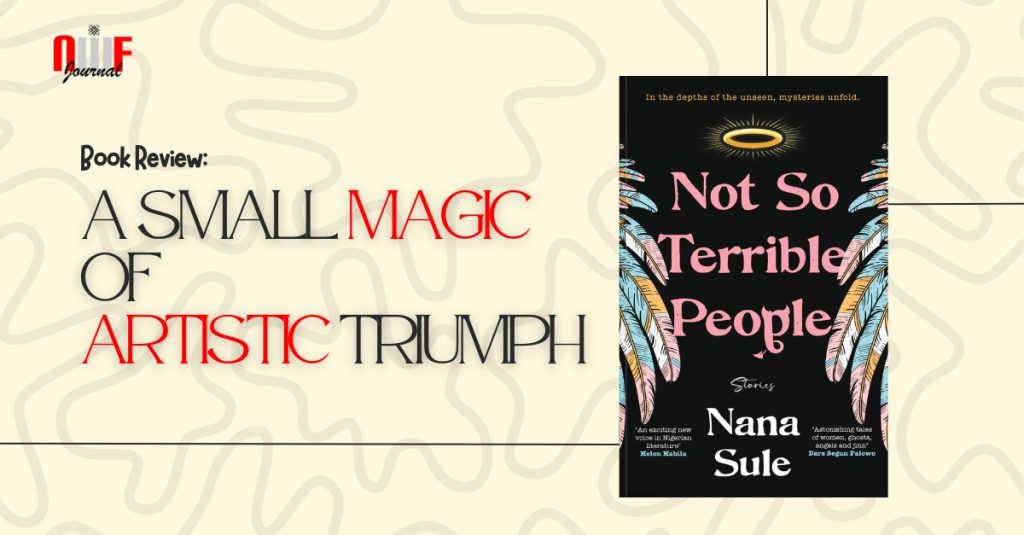
You have read Helon Habila’s Waiting for An Angel, Laila Lalami’s Hope and Other Dangerous Pursuits, and Abubakar Adam Ibrahim’s Dreams and Assorted Nightmares. You are cognizant of the art of interconnecting independent stories. Now, let me introduce you to Nana Sule’s Not So Terrible People. While Habila and Lalami gained global recognition with their aforementioned titles, Ibrahim’s DAAN has become essential reading for anyone seeking to master the craft of writing with artistic precision. The critic, Carl Terver, likened him to “something of a writing dervish” for the book. And in this book, Nana Sule shows similar promise.
I am not a fan of Amal, the opening story in the collection. It’s an interesting conversation between a dying young lady destined for eternal mercy and the Nashitat, a flock of angels responsible for taking the soul of the righteous in Islamic tradition. While fiction writers are free to explore the strange, they are confined by the rules of the art to stick to possibilities. Here, the writer neglects to explain how this interesting incident in the unseen realm gets leaked to the physical realm. I went in search of the witnesses to the event in the subsequent stories but returned unsatisfied with my quest. That said, this flaw is partly redeemed by the story’s exuberant prose and skillful execution.
Speculative stories are not new in the Muslim world. In the early verses of the second chapter of the Qur’an, God mentions the attributes of pious Muslims, beginning with belief in the unseen. Even though faith is required to believe many of these metaphysical narratives, reason and plausibility are not dismissed when relating them.
Take, for instance, the Isra and Mi’raj, Prophet Muhammad’s (PBUH) miraculous night journey from Mecca to Jerusalem and his ascension through the heavens. At a time when such rapid travel seemed impossible, the Prophet (PBUH) recounted riding the Buraq, a celestial steed, accompanied by Angel Jibreel (AS). When skeptical Meccans demanded proof, questioning landmarks and details by those among them familiar with the terrain, the Prophet (PBUH) was there in the night and couldn’t possibly answer the questions. It was said that Jibreel (AS) revealed the scenes to him in real time, allowing the Prophet (PBUH) to answer with uncanny accuracy. Yet, despite this, the disbelievers dismissed it as sorcery.
This episode illustrates a crucial narrative principle: no matter how extraordinary a story may be, the writer bears the responsibility of addressing the reader’s doubts and striving to make the tale feel real.
If the first story casts doubts over Sule’s artistic credentials, then the second story is a statement piece. The prose is nuanced and the speculative character is now believable, giving me the thrill I greatly miss in the character of Amal. This story would later be perfected by the character of Sunday, much later into the collection.
Ohunene, the third story, is a subtle “men are scum” tale covering the intricacies of living under the same roof with a mother-in-law. Also, it looks like a deliberate effort to raise awareness on obstetrics and the trauma of miscarriage, a theme roundly explored in the collection and how faith could be stretched in a woman with such an unfortunate fate. This particular story, and to some extent the entire collection, like Lola Shoneyin’s The Secret Lives of Baba Segi Wives, is a love note to reproductive health.
The fourth story, Bilya, is three and half page long, and the shortest of all, but understanding it is pertinent to unravelling the central connection between the happenings in the physical and the spiritual realms in the book.
The fifth story comes with both prequel and sequel to the third. It bemoans the practice of cramming too many students in one hostel room in Nigerian universities; how students are forced to seek accommodation off-campus and the security challenges of the option. Disturbing recollection of sexual crimes and their lasting effects on the victims are discussed here.
The sixth story is about a runaway angel. While Sule’s portrayal of angels in this collection, in my opinion, has not been executed with much artistic success, the imagination about a renegade angel is quite admiringly audacious. In Islamic tradition, angels are sheepishly obedient. They don’t disobey orders, but this angel has a twin brother to save and finds himself caught between being dutiful to his master and saving his sibling. He daringly opted for the latter. The angel really caught my attention when he reminds us humans of the honour and privilege bestowed upon us by God: “erring angels do not have the same privileges erring humans do. We are not forgiven or given a shot at redemption like you. We do not get to repent because we were not created to disobey in the first place.”
Before meeting Ometere properly in the seventh story, readers have been introduced to her as a “not-so-terrible” person in the third story. I disagree with the author. Ometere is a terrible person, at least when it comes to making vital decisions in her life. She almost never gets anything right. She is bold and courageous where empathy is needed and the other way round. There is a dangerous stereotype that the author reiterates in this story which doesn’t sit well with me. Ometere is a health worker and a wife who is shaped by some experiences that drive her into adultery. Singling out her time when on call at nights as a convenient period to sleep with other men seems like providing artistic backing to the allegations recently made by the Kano clergyman, Dr Abdallah Gadon Ƙaya, that female health workers are promiscuous. The fact that her husband has abandoned her, the writer has other alternatives of time for the character to seek warmth in the arms of other men and not during night calls at the hospital.
I think the character of Ozovehe in the eighth story is more deserving of the not-so-terrible title than his sister, Ometere. He ends up with a very devastating fate. His story shows how little decisions can alter our entire life course.
Rahinat, the ninth story, is easily my favourite in the collection. The titular character is faced with the dilemma of spending her lifetime savings to save a kidnapped relative. Sunday, a friend she indulges in the game of banters, encourages her not to overstretch her pocket. The advice comes in handy. She has a dark history with this relative. He molested her as a child and as Sunday suggests, she “lock up”— the pidgin for doing nothing. Here, Sunday bears witness to the story of Owanyi.
In the penultimate story, we meet Oyiza, a young lady battling to be loved just as her sister by their parents and the last story unites the physical and the spiritual realms. We witness the rebirth of Iblis, who wishes for a life in human flesh in order to atone for his sins.
While titling stories after characters is a creative laziness which I abhor, the competence deployed in telling these stories is a small magic of an artistic triumph that I behold. This collection is technically a novel, with its interwoven narrators similar to Leila Aboulela’s River Spirit. Polished like a master’s poetry, it is witty, concise and curious. A remarkably strong debut that introduces Nigerian readers to a not-so-common writer.