
So You Want to Read for Free?
Mar 22, 2026

Literary journal of the Northern Writers Forum.





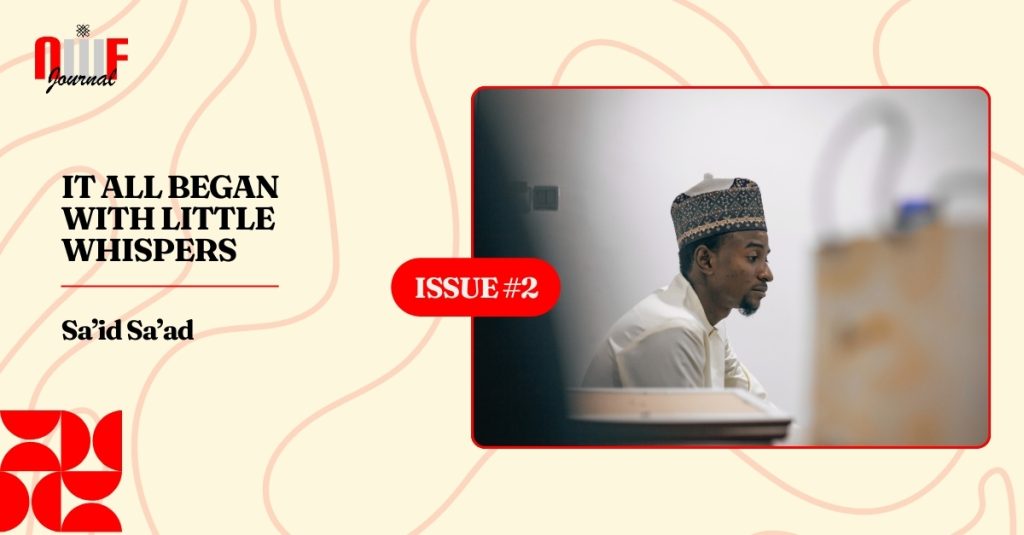
It was an early morning on an ordinary July day. The earth had dried from the previous day’s rain, and the air felt heavy, thick with an unspoken tension, as though the sky itself carried a guilty secret. If I had been more observant, maybe I would have noticed the unease pressing down, the way the silence felt unnatural. The streets held their breath. Our lips, our feet, even the trees. All still. Only the murmur of water flowing through the drainage in front of our house dared to move. We were alert, but we didn’t know what to expect. What we did know was that a religious extremist group named Yusufiyya had declared war.
The night before, almost every non-Muslim family in our community had fled to the military barracks, seeking safety. But we hadn’t left. How could we, when none of us knew what we were running from? Maybe the others had received warnings that we didn’t. Maybe, because we were Muslims, we weren’t expected to run. Maybe, because the war was waged by a Muslim extremist group, we were meant to die in their hands.
It started suddenly, tearing through the quiet. Thunderous gunfire erupted, rattling the air. It wasn’t just one weapon; it was many, each speaking in violent bursts from every direction, north, south, east, and west. I had never heard anything like it. As a teenager, the sounds twisted inside me, making my stomach feel hollow and my hands tremble. My heart pounded so hard I thought it might break free from my ribs.
In an instant, my family and I scattered and then converged under the concrete slab in the middle of our spacious home. It was instinct. A desperate, unspoken agreement. The slab sat between our parlour and an open chalet, its tiled floor was cold against my skin. We lay there, pressed against the earth, hoping somehow that it would shield us. It was common knowledge: when gunfire broke out, you lay down.
When the first shots rang out, we abandoned everything. Breakfast sat half-eaten. Brooms and buckets were cast aside. The scent of burning food drifted in the air. For a moment, it felt absurd that the world could end on a day when ordinary people were doing ordinary things.
Then came the helicopters. Their roar swallowed the sky. They hovered, searching, then dipped forward, spitting fire like dragons. With each blast, the air thickened with dust. The way dust rose when we played football on bare ground just like that, but bigger, heavier, choking the sky. Smoke followed, curling like a sandstorm, interwoven with fear.
My father ordered silence. If you must speak, it had to be no more than a whisper. Or a gesture, if necessary. He didn’t place a finger to his lips. He didn’t need to. One look was enough.
The bombs. The endless gunfire. The ceiling trembled. Dust settled over us like a shroud. My father, cautious but fearless, rose and peered outside from the shelter of the chalet. The building was just tall enough to give him a view, just short enough to keep him hidden. He watched. Then he returned.
The gunfire continued. But little by little, our fear dulled. Not into courage, but into numbness. One by one, we sat up, no longer paralyzed, desperate for information. This was not the time of Google searches and instant news updates. It was 2009. Not every adult I knew even owned a phone.
I was just 13 years old. Still new to the sounds of chaos. I had, through movies, vicariously seen how wars ruined cities, sitting safely on the couch in our living room. I had watched the news, seen buildings collapse, streets burn. But I never imagined it would be this close to me.
So, we listened. And rumours found their way to us, carried in hushed voices from house to house. Some swore that the Yusufiyya had taken over. That the police stations had fallen. That government forces were fleeing, overpowered. Some said they were just a stone’s throw away from West End, and if they reached the railway, they could take Maimalari barracks. If they took the barracks, they could take the state. Everything, we were told, was almost taken. The only thing not taken was probably you, the one listening to the rumor.
The stories were as sharp and frightening as swords. My father always said, “Exaggerated stories during war kill more than bullets.” So, he learned to cover his ears.
My mind spiraled. What if they won? What if they came for us? What if this was the end? I was thirteen, and war was no longer something I watched on the news. It was here. It was real.
We tiptoed around the house. No one spoke. Yet no one could be alone. We looked at each other, gauging the fear in our eyes, then dropped our heads, as if we could consume each other’s fear with our gaze. My father’s eyes became a valley. Deep. Fearful. Yet brave. Undefeated. He looked like a warrior. I still don’t know how he mastered this art being unsure, being afraid, yet appearing unshakable. As though his presence alone could hold the world together.
The sounds lasted for hours. And then, as the sun unfolded itself, the morning died with the gunfire, leaving only sporadic shots like the knockouts my Christian friends and I used to set off on Christmas Eve.
By noon, the sky exhaled. The helicopters vanished. The bombs ceased. The streets remained silent, but now, fear had taken the place of gunfire. We heard that many soldiers had died. And we knew what that meant. One dead soldier could mean ten dead civilians. Retribution was coming.
A three-day lockdown was imposed. The state’s only answer to the chaos.
Moses, our Christian neighbor – who had long since become family – had stayed behind when the other Christian families, including his own, fled. He had lived with us for over a decade. So, he stayed. Maybe he felt safer with us. At my age, it was difficult to read people’s faces. More difficult to read their feelings.
That afternoon, Moses pulled me aside and whispered a request: he wanted me to go with him to the barracks. His family was there. They needed food. And if we didn’t go now, we might not get another chance.
I agreed without thinking. Maybe it was curiosity. Maybe I wanted to see the outside world. Maybe I wanted a story to tell my friends later, exaggerated with the thrill of adventure.
Moses had a motorcycle. If we were lucky, we could be back in thirty minutes.
No one dared to leave the house, so I snuck out when the eyes watching the gates had wilted. Moses refused to start the bike until we had walked far enough not to be heard. He pushed it down the street before finally starting the engine. We rode.
The roads were empty. Houses locked from within. We passed streets where walls had crumbled, where bullet holes let us peer into once-private compounds. When we reached the highway, smoke from burning tires curled into the sky. Soldiers stood like statues, rifles ready. None of them stopped us.
At the barracks, reality struck. Hundreds of families had taken shelter on the parade ground, clutching what little they had. Safe, but not really. Moses handed his family the food. No words. No hugs. Just urgency.
As we turned to leave, a military truck pulled up. Soldiers dragged two men from a vehicle and forced them to their knees. One wore a white kaftan. The other, a sky-blue one. Their beards were rough. Their eyes darted, searching for something, someone to save them.
A minute of questioning. A sharp, quick gunshot.
They crumpled.
I had never seen a man die before. A moment ago, they were speaking. The next, they were gone.
Moses started the bike. No one stopped us. We left.
No one called them Boko Haram yet. That name would come later.
That day, bodies littered the streets. No one counted the dead. The military had won.
But this was just the beginning.
Sa’id Sa’ad is a Nigerian writer and journalist. He is the author of the pocast- play “Gangare.” He won the Peace Panel Short Story Prize 2018 and NFC Essay Prize same year. Sa’id currently lives in Germany and works for the German international broadcaster Deutsche Welle (DW) in Bonn.